From crafting AI chatbots to retiring entire sites.
My work at DBT has been wonderfully varied.
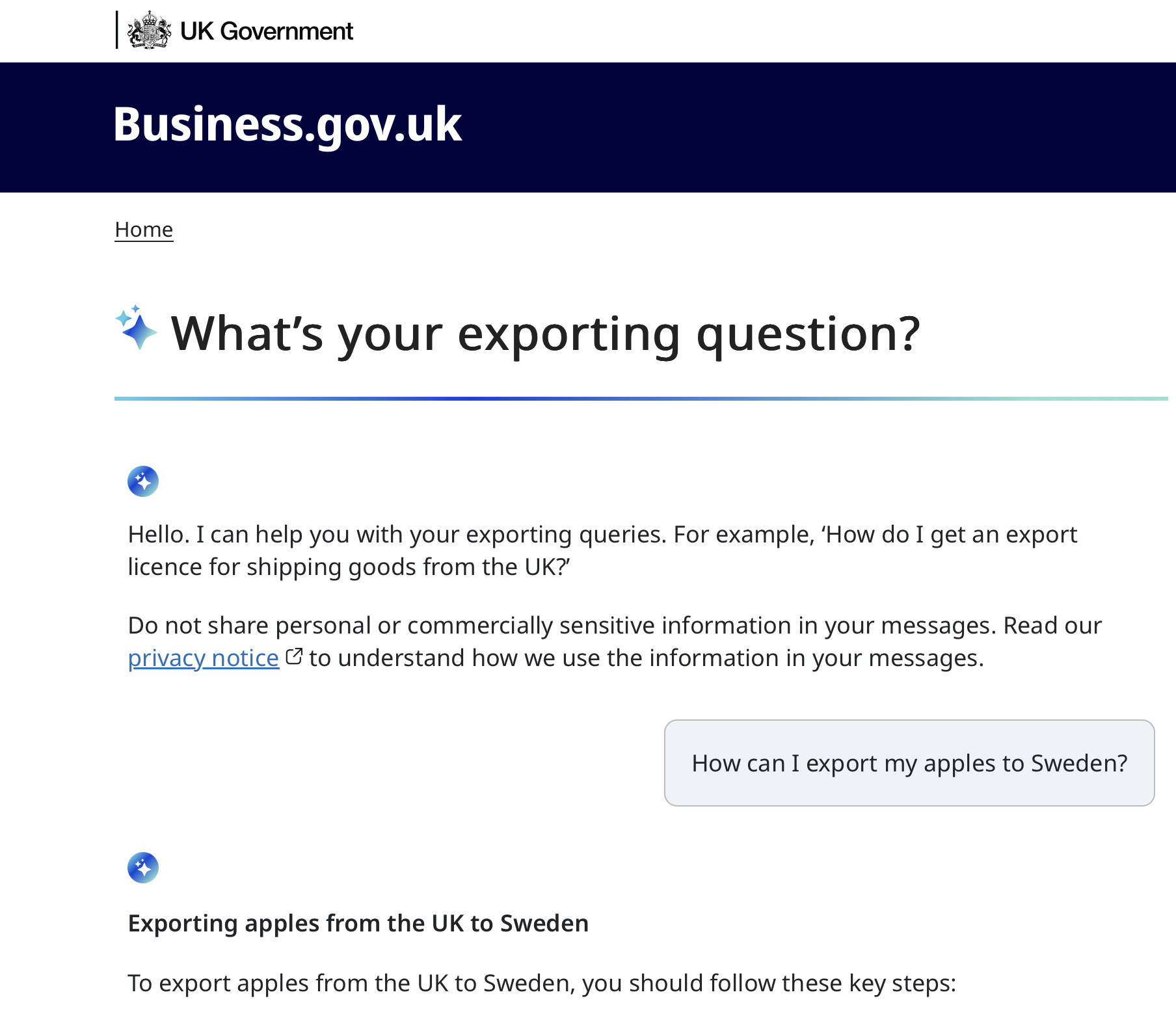
I collaborated with a Project Manager and an Interaction Designer at the Department for Business and Trade (DBT) to design and deliver an AI-powered chatbot, using Microsoft Copilot, that helps UK businesses navigate the complexities of exporting products overseas.
The core goal was to transform dense, fragmented information on exporting codes (e.g., HS codes), logistics, required documentation, tax and VAT considerations, and legal/compliance requirements into clear, actionable guidance.
Objectives
Simplify complexity: Break down regulatory and procedural information into plain language.
Personalization: Tailor responses based on the user’s business type, product category, destination country, and experience level.
Focus: Deliver only essential, relevant advice while explicitly avoiding generic or non-applicable information.
User-centric design: Base the entire experience on real user needs rather than assumptions.
Exporting chatbot (Copilot)

Discovery and User Research
Before touching any technology, we prioritised deep user understanding. We partnered closely with user researchers who conducted interviews, surveys, and journey-mapping sessions with exporters ranging from small SMEs to larger manufacturers.
This phase revealed common pain points:
Users felt overwhelmed by government websites and PDFs.
They struggled with knowing where to start (e.g., “What code do I need for my product?”).
Many needed country-specific or product-specific pathways rather than broad overviews.
Success highlight
The research directly shaped the chatbot’s knowledge base and conversation flows. We created a comprehensive set of user question archetypes (e.g., “Can I export X to Y?”, “What documents do I need?”, “How do I handle VAT?”). This prevented us from building a generic tool and ensured high relevance from day one.

Requirements and Scope Definition
We translated research findings into detailed requirements:
Dynamic personalisation (capturing business context early in the conversation).
Structured data integration (export codes, country profiles, documentation checklists).
Guardrails to keep responses concise and focused.
Clear handoffs to human advisors or official forms when the query exceeded the chatbot’s scope.
Interaction Design and Conversation Architecture
Working with the Interaction Designer, we mapped out conversation trees, intent recognition, and response templates. We focused on:
Progressive disclosure (start broad, then drill down based on user inputs).
Natural, helpful tone that builds user confidence.
Visual aids where helpful (checklists, links to official forms).

Development in Microsoft Copilot Studio
We built the chatbot using Copilot Studio, leveraging its low-code capabilities for:
Generative AI responses grounded in official DBT content.
Topic orchestration and entity extraction (product type, destination, etc.).
Integration with backend knowledge sources for accuracy.
Feedback Mechanism Design and Iteration
There was initial discussion about implementing:
Inline feedback buttons after every response.
A mandatory “Why?” free-text field if users selected “Yes, this was helpful.”
My Pushback & Outcome:
I strongly advocated against both. Constant inline feedback creates friction and survey fatigue, which harms user experience, especially for users already dealing with complex export processes. A mandatory “Why” field on positive feedback adds unnecessary burden and risks low completion rates with low-value data.
Instead, we implemented a lighter, smarter approach:
Feedback prompted at logical conversation endpoints or after key multi-turn journeys.
Simple thumbs up/down.
Analytics on conversation completion and drop-off points for passive insight.
Success highlight
This decision improved user flow and satisfaction. Post-launch data showed higher completion rates and more authentic qualitative feedback.
Overall Successes
High Relevance & Usability: The research-driven design meant the chatbot consistently delivered tailored, non-generic answers. Users reported significantly reduced time spent searching for information.
Simplified Complexity: Complex topics like HS code classification, Incoterms, or destination market regulations were distilled into step-by-step guidance without overwhelming users.
Efficient Delivery: By pushing back on heavy feedback mechanisms, we maintained momentum in the user experience while still gathering actionable insights.
Scalable & Maintainable: The Copilot Studio implementation allowed the content team to update knowledge easily as regulations changed.
Positive User Impact: Early testing and metrics showed users felt more confident exporting, with fewer errors in documentation and faster decision-making.
This project demonstrated the value of putting user research first, maintaining disciplined focus on core needs, and making pragmatic design decisions even when they challenge initial stakeholder suggestions. The result was a practical, helpful tool that genuinely reduces barriers for businesses looking to grow internationally.
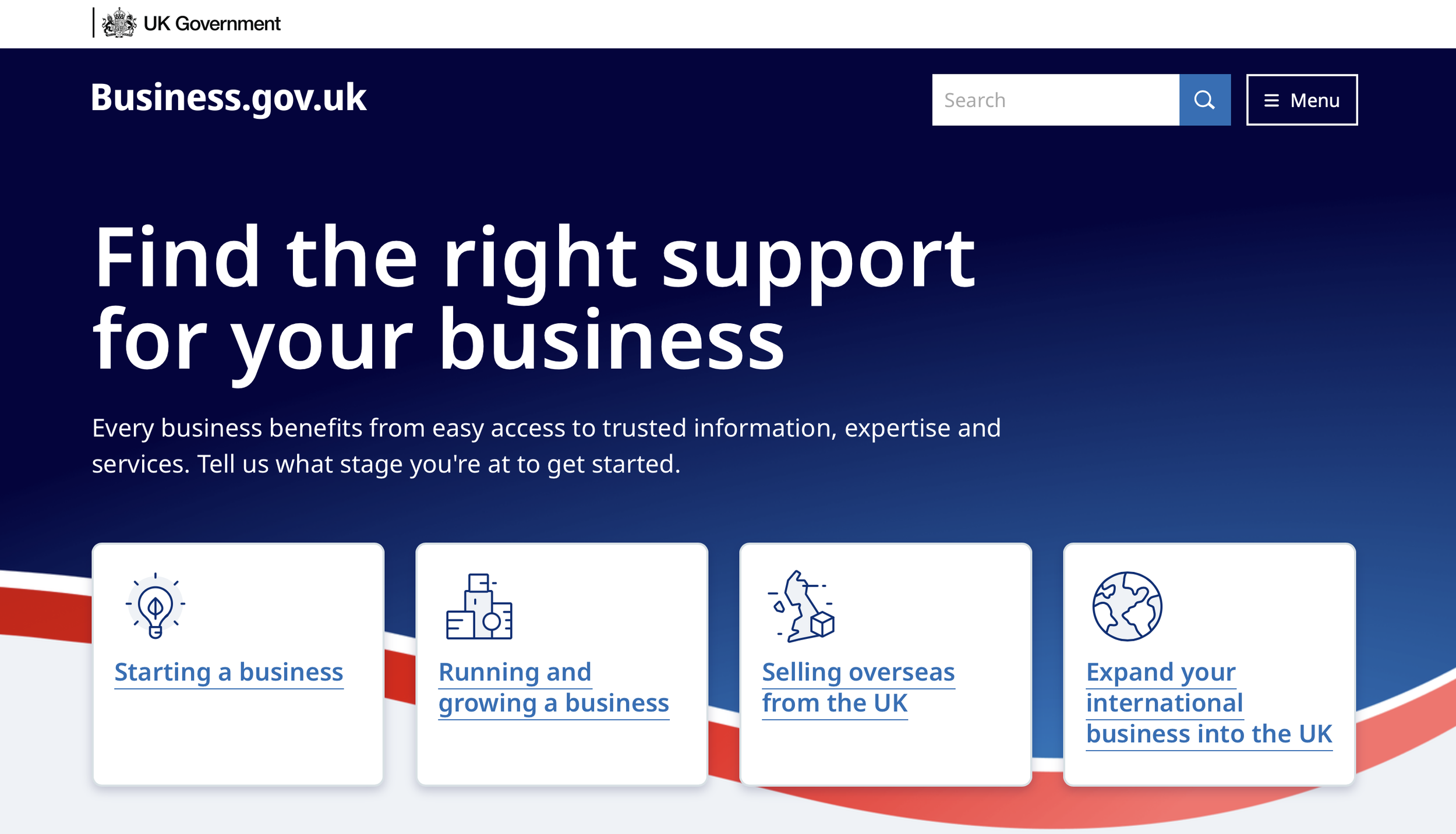
As the lead content designer, I led the end-to-end retirement of helptogrow.gov.uk, a legacy government website that was no longer aligned with DBT’s strategic direction to consolidate business support content onto the single, authoritative platform; Business.gov.uk.
Working closely with one other content designer, I designed and executed a comprehensive content migration and decommissioning project. The process included:
Content Audit and Inventory
Conducted a full content audit of helptogrow.gov.uk, systematically crawling and cataloguing every page, guidance document, tool, form, and downloadable resource.
Created a detailed master spreadsheet (with columns for URL, page title, content type, word count, last updated date, traffic data, user journey mapping, and current status) to provide complete visibility and enable data-driven decision making.
Retiring helptogrow.gov.uk

Gap Analysis and Content Mapping
We cross-referenced every piece of content against business.gov.uk to identify what already existed in an up-to-date, user-centred form.
For content that had not yet been transferred, performed a needs assessment based on:
Current user need and search volume (using Google Analytics and Search Console data)
Alignment with current DBT policy and business support offers
Readability, accessibility (WCAG 2.2), and plain English standards
Duplication risk and maintenance burden
Success highlight
I identified that over 65% of the existing content was either duplicated onbusiness.gov.uk or outdated. By recommending the retirement of redundant pages, we prevented the risk of users receiving conflicting advice across government websites and pages.

Decision Making and Recommendations
First I categorised all un-migrated content into clear recommendations: “Migrate and Improve”, “Archive”, or “Retire Without Replacement”.
I then rewrote or significantly improved pages that were selected for migration, applying user-centred design principles, better information architecture, and clearer calls to action.
Finally I prepared a detailed options paper and presented recommendations to the senior leadership team (including Director-level stakeholders), clearly outlining risks, benefits, cost savings, and SEO implications.
Success highlight
My recommendations were fully endorsed by senior leadership. As a result, we successfully migrated only the highest-value content while decommissioning the remainder, significantly reducing DBT’s content maintenance overhead.

Execution and Site Retirement
I coordinated with digital, SEO, policy, and technical teams to implement redirects (301s) from old URLs to the most relevant pages on business.gov.uk, preserving SEO value and user journeys.
Following this I updated all internal links, removed references to the old site from GOV.UK, and ensured no orphaned content remained.
I then developed and executed a communications plan to inform users and stakeholders of the change, minimising disruption.
I finished by conducting final quality assurance checks and post-retirement monitoring to confirm traffic was successfully redirected and users were finding the information they needed on the new platform.
Successes:
Delivered a clean, low-risk retirement of the entire domain with zero major incidents.
Improved overall user experience by directing users to modern, accessible, and consistently branded content on business.gov.uk.
Achieved significant efficiency gains by reducing the government’s business support content footprint and eliminating duplicated effort.
Demonstrated strong stakeholder management and strategic content leadership throughout the project.
This work formed a key part of DBT’s broader digital consolidation programme, ensuring users receive clearer, more reliable support through a single trusted platform.