My work at Cardiff Council had unique challenges, and unique rewards.
All work needed to be completed bilingually.
Leading the creation of a new Cardiff housing website
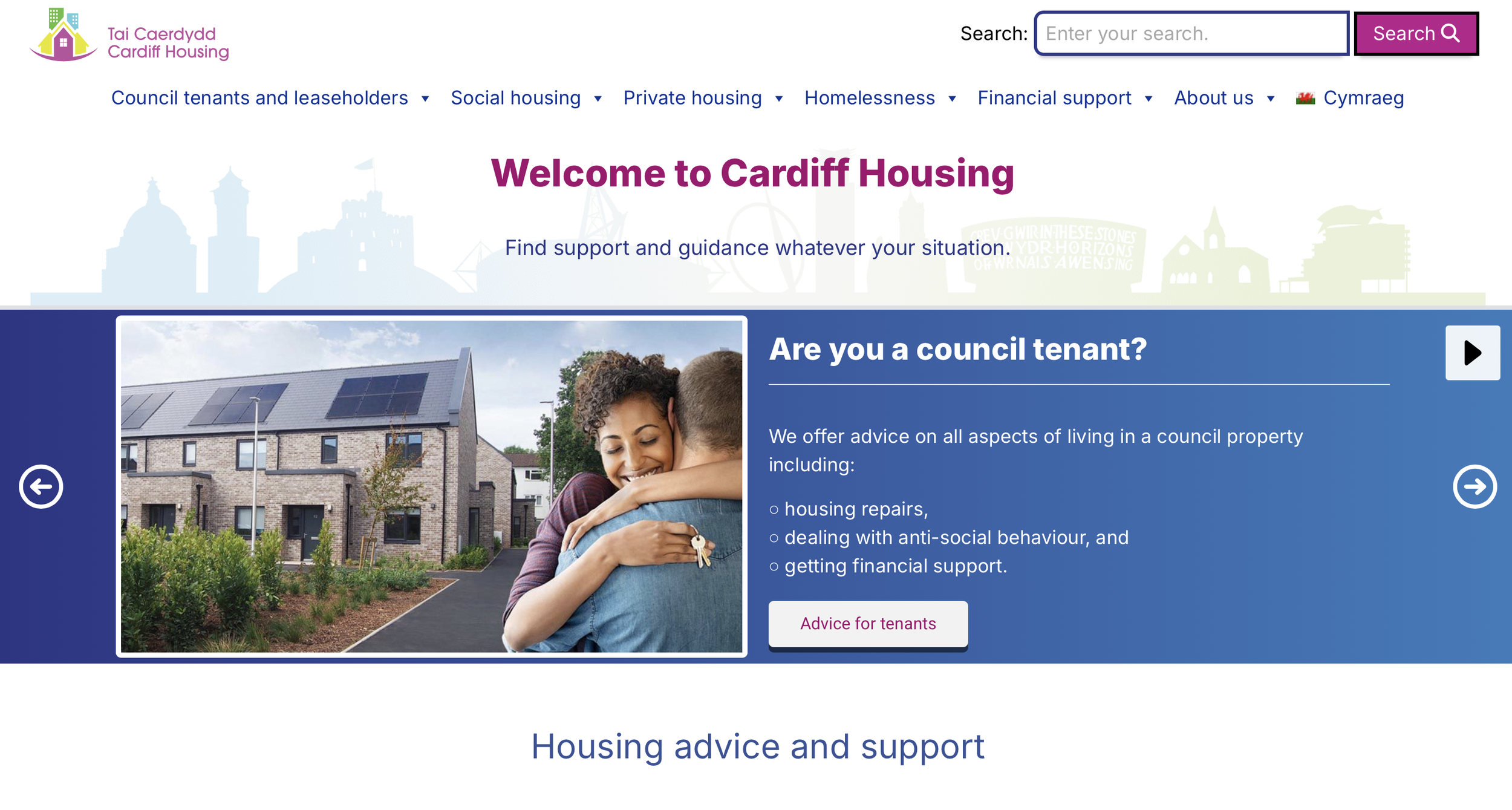
As a Content Designer at Cardiff Council, I led the complete overhaul of the Cardiff housing website, transforming it from a subsection of the main council site into a dedicated, standalone platform at cardiffhousing.co.uk. This project aimed to better serve residents needing housing information, applications, tenant support, and advice by creating a user-centred, accessible, and intuitive digital service
Stakeholder Engagement and Content Discovery
I initiated comprehensive discovery sessions with key stakeholders across the council, including housing officers, tenancy support teams, repairs and maintenance, policy teams, digital services, and legal/compliance experts. Through workshops, interviews, and collaborative audits, I gathered all existing content, processes, and service information.
This involved mapping complex housing pathways such as social housing applications, allocations, repairs reporting, anti-social behaviour reporting, and tenancy management.
I identified outdated, duplicated, or overly bureaucratic language and prioritised content that aligned with user needs rather than internal structures. I created a central content inventory and established clear governance for future updates.

User Research and Insight Gathering
I conducted targeted user research with Cardiff residents, including current council tenants, housing applicants, and those seeking advice.
My methods included:
One-to-one interviews and focus groups with diverse participants (varying by age, digital literacy, ethnicity, disability, and housing need).
Online surveys distributed via community hubs, libraries, and tenant associations.
Usability testing of existing pages and prototypes.
Analysis of analytics data, support call logs, and common queries to identify pain points (difficulty finding repair reporting tools, unclear application processes, or inaccessible jargon).
Key insights revealed that users wanted quick, task-oriented information in plain English or Welsh, mobile-friendly design, and clear signposting for urgent issues like damp/mould or emergency repairs. I translated these findings into user personas, journey maps, and content requirements.

Information Architecture and Content Strategy
Using research, I redesigned the site's structure around user tasks and life events rather than council departments which included:
Creating clear navigation for distinct audiences (e.g., "Tenants," "Applicants," "Landlords").
Developing a new content style guide emphasising plain language, accessibility (WCAG compliance), and readability.
Writing and rewriting all core content (application guidance, repair processes, policy explanations, and support resources) into concise, actionable pages with strong calls-to-action.
Implementing consistent patterns for forms, FAQs, and downloadable resources.
Ensuring integration with backend systems like Housing Online for applications and repairs.
Collaboration, Iteration, and Testing
I worked closely with designers, developers, and accessibility specialists to prototype and iterate the new site. This involved multiple rounds of user testing to refine wireframes, content, and interactions.
I facilitated training for content owners on maintaining the new standards and established workflows for ongoing content reviews to keep information accurate and up-to-date.
Successes
Improved User Experience and Accessibility: The standalone site provided a more focused, less cluttered experience than the previous embedded section, leading to better task completion rates in testing. Content became significantly clearer and more inclusive, reducing reliance on phone support for basic queries.
Higher Engagement and Efficiency: Post-launch metrics (where available) showed increased traffic to key services like housing applications and repair reporting, with users completing tasks more quickly due to intuitive structure and plain-language content.
Better Service Outcomes: By centralising accurate information, the site helped reduce administrative burden on housing teams and empowered residents to self-serve effectively. It supported broader council goals around housing supply and tenant wellbeing.
Recognition of Best Practice: The project demonstrated strong user-centred design principles, serving as a model for other council service areas transitioning to standalone digital platforms. It successfully balanced complex policy/legal requirements with resident-friendly communication.
This overhaul not only modernised the housing digital presence but delivered tangible benefits to Cardiff residents by making essential housing services easier to access and understand. I'm proud of how the collaborative, research-driven approach resulted in a website that genuinely puts users first.